Fresh fruit

The entire packing chain, from plant to shift.

Seven modules, from the season's S&OP to the close of every shift: S&OP sets how much fruit goes to each market and week, curve estimation anticipates what each lot will yield, plant allocation feeds the weekly schedule, the schedule cascades down to each shift and each line's outlets and, at close, reconciliation aligns output with what the sorter measured.

  • Cherries
  • Blueberries
  • Stone fruit
  • Kiwi
  • Grapes
  • Avocados
  • Citrus
  • Apples
  • Pears
  1. 1

    Fresh fruit S&OPPilot

    How much fruit goes to each market and week, and with what capacity?

    The season plan by week and market: recipe by size, materials, processing and cold-storage capacity, with scenarios and a current plan that is approved and frozen. Its targets cascade down to plant allocation and weekly planning.

    • Committed demand
    • Capacity and cold-storage use
    • Scenarios compared
  2. 2

    Curve estimation

    What will each lot yield, before it is processed?

    Corrects each lot's sampling with what the plant actually produced, by grower, variety and day, and gives a size curve and export % even to lots with no characterization. Weekly and shift planning use it instead of raw sampling.

    • Size curve per lot
    • Estimated export %
    • Unsampled lots covered
  3. 3

    Plant allocation

    Which fruit and which order goes to each plant?

    Allocates fruit and orders to plants over a two-week horizon, prioritizing by shipping date, completing order lines and keeping grower groups together.

    • Order kilos fulfilled
    • Complete order lines
    • Unassigned fruit
  4. 4

    Weekly planning

    Which lines should run each shift of the week?

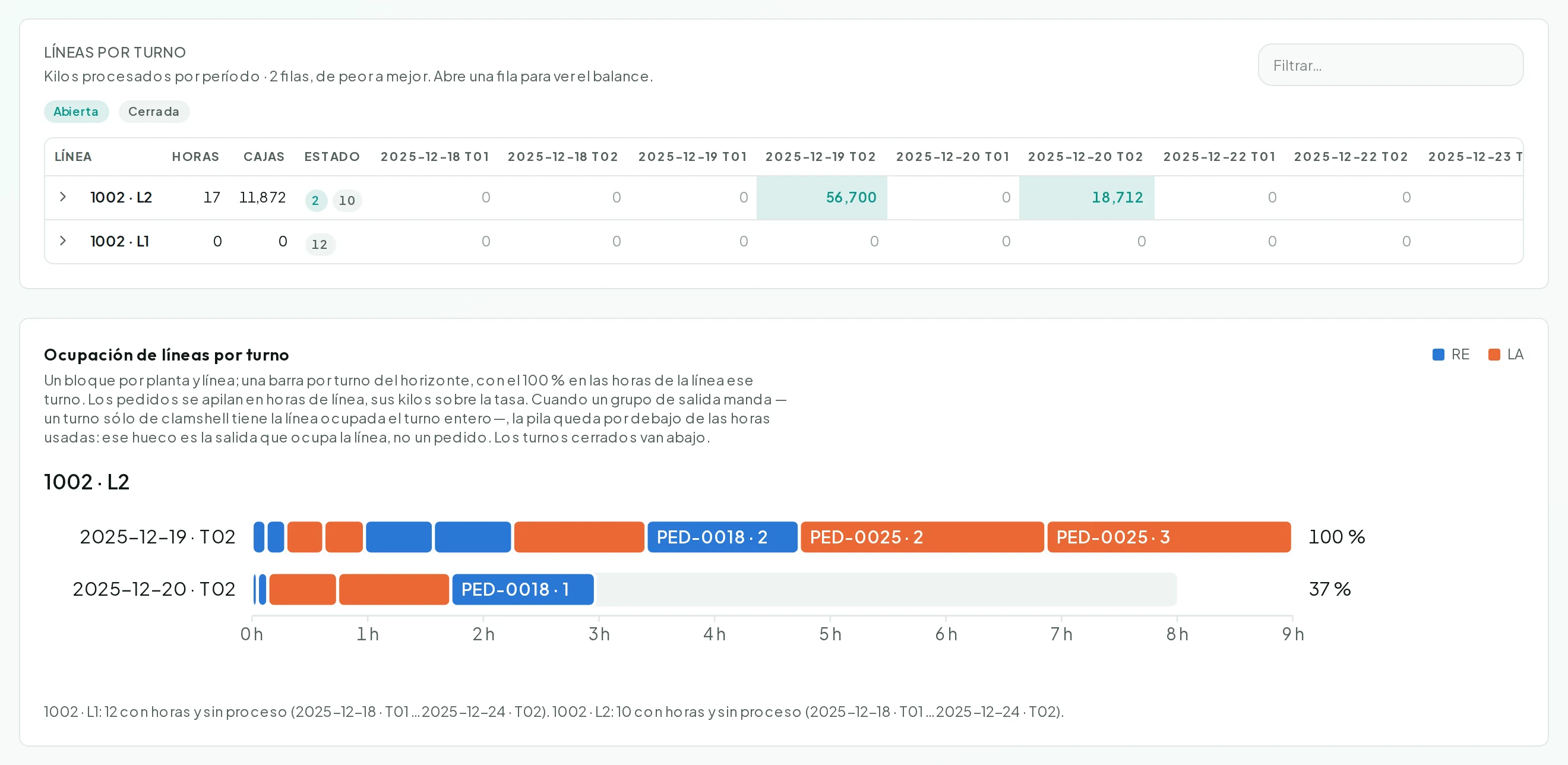
    Decides which lines to open each shift and when to process each order, based on the harvest estimate and each line's real capacity.

    • Line-shifts opened
    • Planned boxes
    • Kilos fulfilled
  5. 5

    Shift planning

    Which lot goes to which line, in what order and for which order?

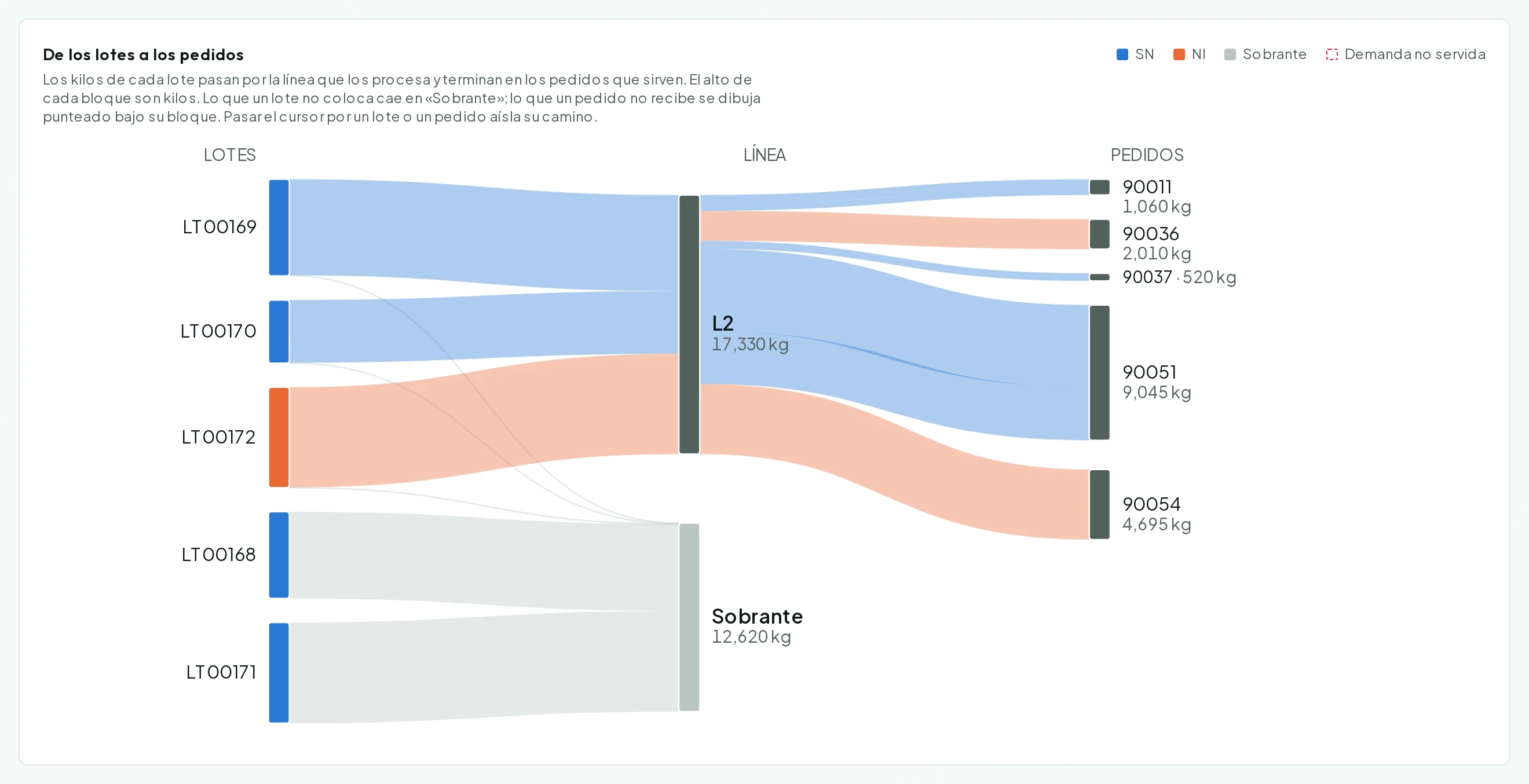
    Assigns lots to lines and boxes to orders for one or two shifts, respecting capacities, the packing matrix, lot age and market eligibility. Minimizes variety and kit changeovers.

    • Demand fulfilled
    • Line utilization
    • Unplaced kilos
  6. 6

    Outlet planning

    Which size does each outlet handle, and with which kit?

    For each line's lots, defines which size and color each outlet handles, when to change kits and the resulting line speed. It's the operator's run sheet.

    • Planned vs. shift hours
    • Kit changes
    • Idle outlets
  7. 7

    Process reconciliation

    How do you reconcile output with what the sorter measured?

    At the end of the shift, moves boxes between compatible processes so each process's export % and size curve match the sorter, while keeping the mass balance.

    • Processes reconciled
    • Deviation before and after
    • Boxes moved
Planificación semanal: kilos por línea y turno, y ocupación de cada línea por pedido
Planificación de turnos: flujo de lotes a la línea y a los pedidos

Market compliance built in

Phytosanitary and commercial requirements live inside the model: protocols for China, Korea and Vietnam, GGN, multi-residue, quarantine zones and lot-level conditions. A misspelled country won't switch off a rule.

+6–10%

fruit per line hour, with fewer variety and kit changeovers

+2 USD

per kilo at most, when fruit moves from generic programs to a better-paying order

-50%

in people dedicated to building the plan

«We didn't just cut hundreds of hours of operational workload: we transformed the dynamics and mindset of our teams.»

Sebastián Araya · Deputy Planning Manager, Export Division, Garces Fruit

Coming modules

  • Harvest estimation
  • Margin-driven S&OP across countries
  • Grower bin management
  • Box packing
  • Container planning

Let's pick the first decision to optimize, together.

A pilot with one of your decisions and your real data, and the first compared plan in weeks.

Book a Cromax demo

We evaluate together whether there is a real opportunity

Diagnostic questionnaire

You complete a short form about your process, systems and volumes to validate fit before meetings.

Business case analysis

We meet to understand the challenge, estimate the solution's potential value, and confirm whether a clear opportunity exists.

Tailored proposal

If there is a clear opportunity, we prepare a proposal with scope, timeline and pricing adapted to your operation.

Tell us about your operation

Fill out the form and we will get back to you by email to schedule a conversation.

We will reply by email to arrange a first conversation.